
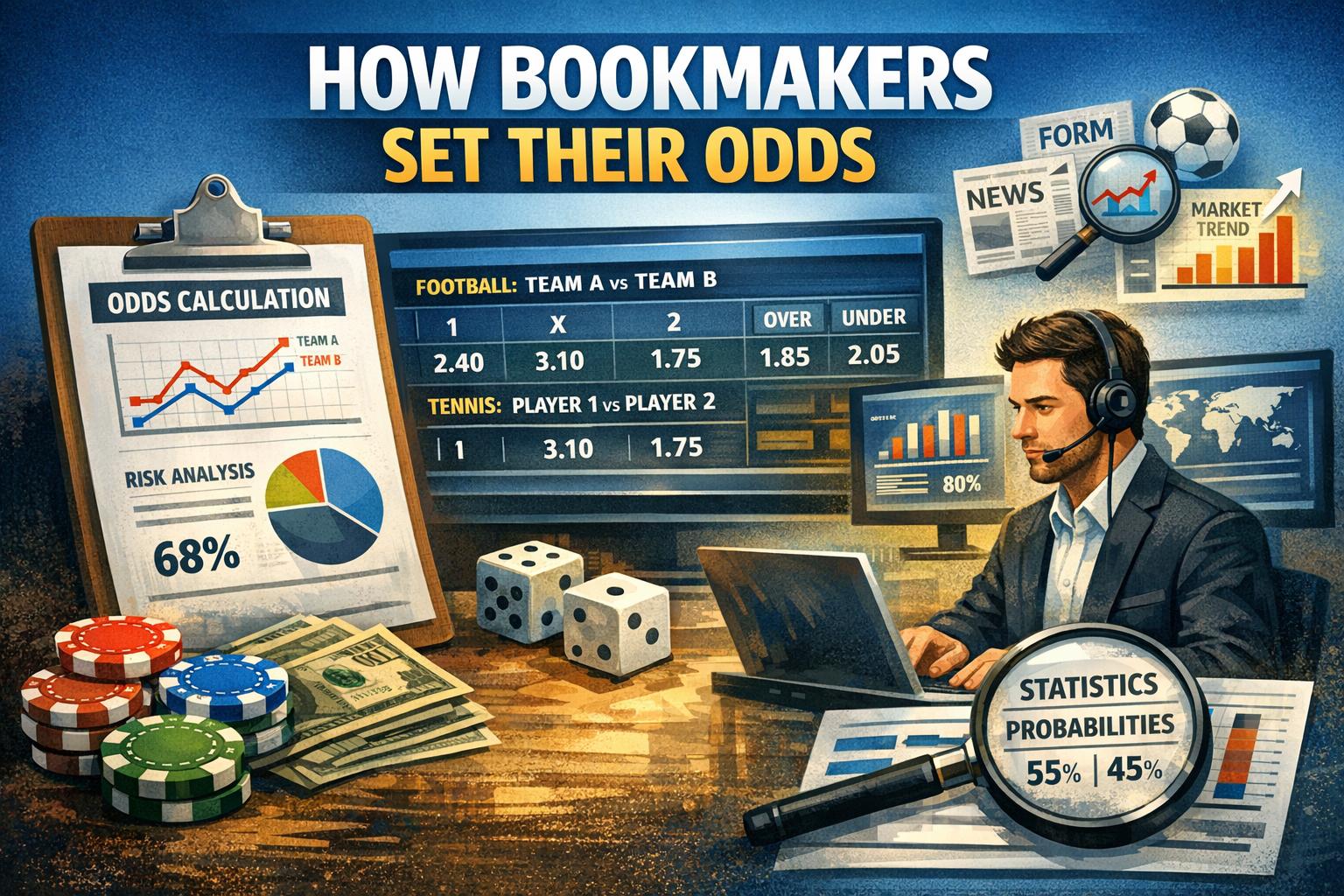
How bookmakers set their odds.
Understanding the Basics of Odds
In the world of sports betting, bookmakers set odds to represent the probability of different outcomes occurring in an event. These odds are carefully calculated to reflect both the likelihood of an outcome and the need for the bookmaker to operate a sustainable business. Rather than selecting numbers arbitrarily, bookmakers rely on structured analysis, statistical tools, and market observation. Odds serve two central purposes: they communicate probability to bettors, and they determine the payout a bettor will receive if a wager is successful.
At their core, odds are a pricing mechanism. They translate uncertainty into numerical values. When a bettor views odds for a football match, tennis game, or horse race, those figures encapsulate the bookmaker’s assessment of each possible result. The lower the odds, the higher the implied probability of that outcome occurring. Conversely, higher odds indicate a lower implied probability.
The Role of Probability
Probability forms the foundation of all odds setting. Before publishing odds, bookmakers estimate the chance of each outcome using a combination of historical performance data, statistical modeling, and expert judgment. In football, for example, analysts may examine recent results, player statistics, head-to-head records, tactical approaches, and home-versus-away performance. These inputs are entered into predictive models that generate probability estimates.
Once probabilities are established, they are converted into odds. If a team is assessed to have a 60% chance of winning, the implied fair decimal odds would be 1.67, calculated as 1 divided by 0.60. However, bookmakers rarely publish perfectly “fair” odds. Instead, they adjust them slightly to incorporate their margin.
Probability assessment is an ongoing process. Bookmakers continuously update their models as new data becomes available. A change in weather conditions, a managerial announcement, or updated injury information can alter probability calculations significantly. This dynamic approach ensures that odds remain aligned with the most accurate information available at any given time.
Types of Odds Formats
Odds are presented in several standardized formats, each serving the same mathematical purpose but expressed differently depending on regional preference.
Fractional odds are traditionally used in the United Kingdom and Ireland. Displayed as fractions such as 5/1 or 10/3, they indicate the profit relative to the stake. For example, 5/1 means a bettor earns five units of profit for every one unit wagered, plus the original stake returned.
Decimal odds are common in Europe, Canada, and Australia. These are typically easier to interpret because they show the total return for every unit wagered, including the original stake. Decimal odds of 2.50 mean that a one-unit bet returns 2.50 units in total if successful.
Moneyline odds, also known as American odds, are primarily used in the United States. Positive numbers, such as +200, show the profit on a 100-unit stake. Negative numbers, such as -150, indicate how much must be wagered to win 100 units in profit.
Although the formats differ in presentation, they represent the same underlying probabilities. Many online tools and platforms, such as OddsPortal, allow users to convert between formats for clarity and comparison.
Margin and Overround
A key component of odds setting is the inclusion of a built-in profit margin for the bookmaker. This is often referred to as the “vig,” “juice,” or margin. When bookmakers set odds for all possible outcomes of an event, the implied probabilities typically add up to more than 100%. This excess percentage is known as the overround.
To illustrate, imagine a tennis match between two evenly matched players. If each player truly has a 50% chance of winning, fair odds would imply probabilities totaling exactly 100%. However, a bookmaker might price both players at odds implying a 52% probability each. The combined probability would then be 104%, with the additional 4% representing the bookmaker’s margin.
The size of the overround varies depending on the sport, the popularity of the event, and market competition. Highly competitive markets with many bookmakers often feature smaller margins. Less popular events may carry larger margins due to lower betting volume and higher uncertainty.
Adjustments for Market Changes
Odds are not static figures published once and left unchanged. Instead, they fluctuate in response to new information and betting behavior. One significant factor influencing adjustments is betting volume. If a large number of wagers are placed on one side of a market, bookmakers may shorten the odds for that outcome and lengthen the odds for the opposite side. This adjustment helps balance financial exposure and manage risk.
Injury reports and team announcements are equally influential. If a key player is ruled out shortly before a match, the probability of certain outcomes may decrease, prompting immediate odds changes. Bookmakers monitor official announcements, press conferences, and verified reporting sources to react quickly.
Competitive positioning also plays a role. Bookmakers routinely observe each other’s pricing to remain competitive within the broader market. While each bookmaker operates independently, significant discrepancies in odds can attract arbitrage bettors seeking guaranteed profit opportunities. To reduce this risk, pricing remains relatively aligned across major operators.
Technology in Odds Setting
Technological advancements have significantly transformed odds compilation. Modern bookmakers rely on sophisticated algorithms that process vast datasets in real time. These systems evaluate player metrics, team performance indicators, situational variables, and historical outcomes. Machine learning models can identify patterns that traditional statistical methods might overlook.
Live or in-play betting has especially benefited from automation. During a match, odds may update within seconds based on possession changes, scoring events, or time remaining. Automated trading platforms manage these updates with minimal human intervention while maintaining risk controls.
Data providers also contribute to this ecosystem. Companies specializing in sports analytics deliver structured data feeds directly to bookmakers. These partnerships ensure that pricing models are supplied with accurate and timely information.
Market Efficiency and Bettor Behavior
Beyond statistical modeling, bookmakers consider bettor psychology and market behavior. Not all wagering decisions are purely data-driven. Public sentiment, brand loyalty, and media narratives can influence betting patterns. For instance, popular teams often attract disproportionate support, regardless of objective probability.
Bookmakers may anticipate these tendencies and adjust odds accordingly. By doing so, they protect themselves from predictable imbalances while maintaining attractive pricing. In highly liquid markets, collective bettor activity itself can contribute to efficient pricing, as incorrect odds tend to be corrected quickly through wagering pressure.
Professional bettors, sometimes referred to as “sharp” bettors, also influence markets. Their wagers are often based on detailed analysis and may signal that odds are mispriced. Bookmakers monitor such activity carefully and may respond by adjusting lines more aggressively.
Conclusion
Setting odds is a structured and analytical process grounded in probability theory, statistical modeling, and market management. Bookmakers evaluate data, incorporate margins, respond to new information, and adjust to betting behavior in order to maintain balanced books and operational stability. The various odds formats used worldwide are different expressions of the same mathematical principles.
Understanding how odds are developed allows bettors to interpret pricing more accurately and recognize how probability, margin, and market forces interact. While outcomes in sport remain uncertain, the system used to represent that uncertainty follows consistent quantitative methods shaped by both mathematics and market dynamics.