
The concept of implied probability in sports odds.
Understanding Implied Probability in Sports Betting
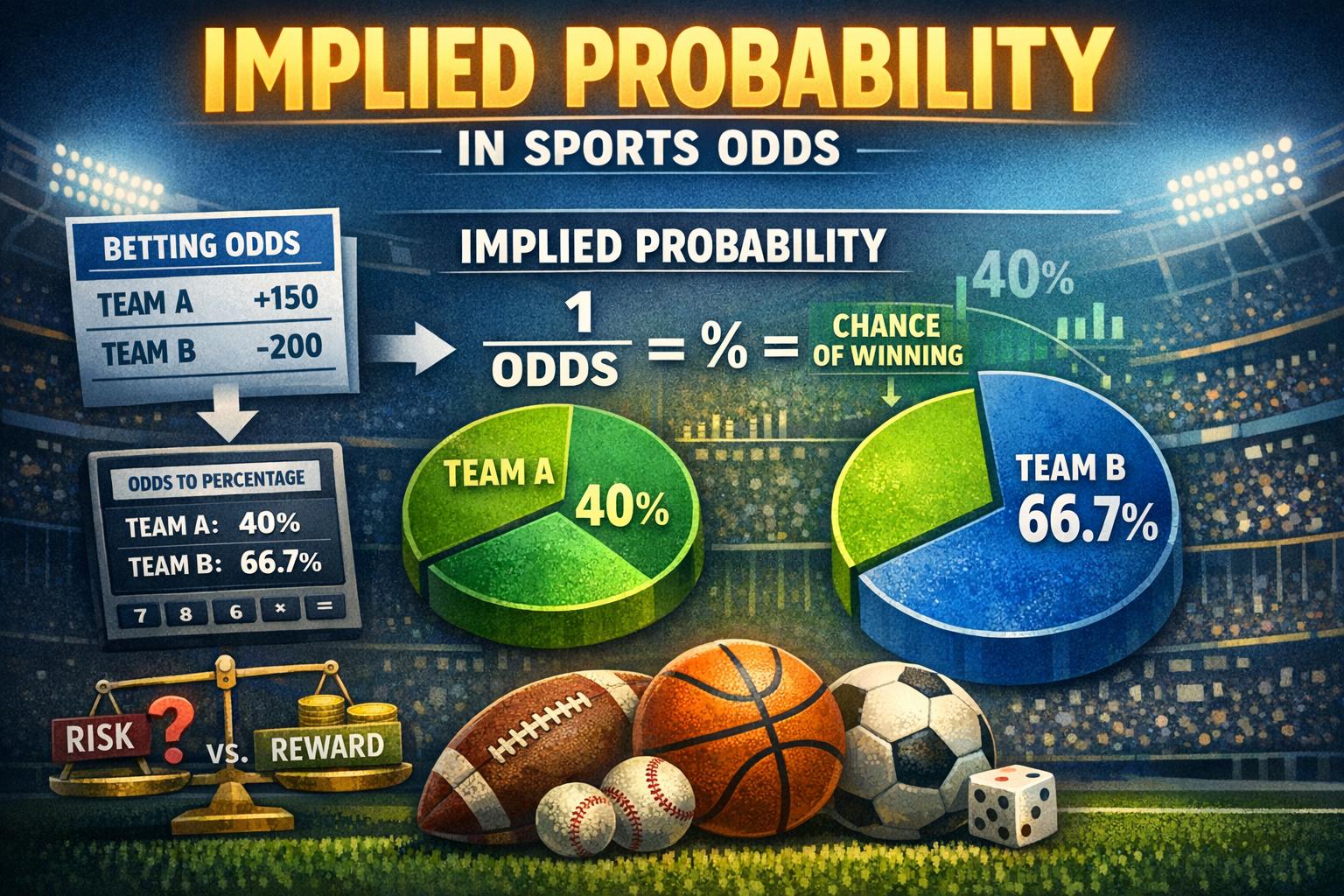
Implied probability is a foundational concept in sports betting that translates bookmaker odds into a percentage representing the likelihood of a specific outcome. Rather than viewing odds solely as a measure of potential payout, implied probability reframes them as a statement about chance. This shift in perspective allows bettors to interpret odds in a more analytical way and compare them to their own assessments of an event.
Every betting market is built around probabilities. Whether the event involves a football match, a tennis tournament, or a horse race, the bookmaker assigns odds to each possible outcome. These odds can be converted into implied probability, revealing the percentage chance the bookmaker has effectively assigned to that result. Understanding this relationship is central to identifying potential value and managing risk.
Why Implied Probability Matters
When odds are presented in decimal, fractional, or American format, they primarily communicate payout. However, experienced bettors focus less on what they stand to win and more on whether the price accurately reflects the true likelihood of an outcome. Implied probability provides a standardized way to make that comparison.
For example, a team priced at odds that imply a 40% chance of winning may appear attractive if a bettor’s independent analysis suggests the true probability is closer to 50%. Conversely, if the bettor believes the team has only a 30% chance, the same odds would represent poor value. In this way, implied probability acts as a bridge between bookmaker pricing and personal evaluation.
Calculating Implied Probability
The method for calculating implied probability depends on the odds format being used. Although the underlying logic remains consistent, each system expresses price differently, requiring a specific formula.
Decimal Odds
Decimal odds are widely used in Europe, Australia, and many international online sportsbooks. They express the total return relative to the stake, including the original wager. Converting decimal odds into implied probability is straightforward:
Implied Probability (%) = (1 / Decimal Odds) × 100
If the decimal odds are 2.50, the implied probability becomes (1 ÷ 2.50) × 100 = 40%. This means the bookmaker is pricing the outcome as if it has a 40% chance of occurring. Decimal odds below 2.00 indicate outcomes considered more likely than not, while higher values correspond to less probable events.
Fractional Odds
Fractional odds are traditionally used in the United Kingdom and Ireland, particularly in horse racing. They show profit relative to stake, rather than total return. The calculation for implied probability is:
Implied Probability (%) = (Denominator ÷ (Numerator + Denominator)) × 100
For odds of 3/1, the formula becomes (1 ÷ (3 + 1)) × 100 = 25%. In this case, the bookmaker suggests a one-in-four chance of success. Shorter odds such as 1/2 imply higher probability, while longer odds such as 10/1 indicate lower probability.
American Odds
American odds, also known as moneyline odds, are standard in the United States. They are expressed with either a positive or negative number. Positive odds represent potential profit on a $100 stake, while negative odds indicate how much must be staked to win $100.
For positive odds, the formula is:
Implied Probability (%) = (100 ÷ (Odds + 100)) × 100
For example, odds of +200 convert to (100 ÷ (200 + 100)) × 100 = 33.33%.
For negative odds, the formula is:
Implied Probability (%) = (Absolute Value of Odds ÷ (Absolute Value of Odds + 100)) × 100
If the odds are -150, the calculation becomes (150 ÷ (150 + 100)) × 100 = 60%. This indicates the bookmaker views the outcome as relatively likely compared to a positive moneyline.
Accounting for the Bookmaker’s Margin
An important aspect of implied probability is that it includes the bookmaker’s built-in margin, often called the overround or vigorish. In a perfectly fair market with no margin, the total implied probabilities of all possible outcomes would sum to exactly 100%. In practice, they exceed 100% because the bookmaker includes a profit margin.
Consider a two-outcome event such as a tennis match. If one player has implied probability of 55% and the other 50%, the total equals 105%. The extra 5% represents the bookmaker’s margin. Understanding this concept helps bettors recognize that implied probability does not reflect a neutral forecast but a priced market designed to ensure bookmaker profitability over time.
Some bettors attempt to calculate the “true” probability by adjusting for this margin. While this can provide additional clarity, it requires further calculation and assumptions about how the margin is distributed across outcomes.
Comparing Implied Probability to Personal Assessment
The practical application of implied probability lies in comparison. A bettor may use statistical models, historical performance data, injury reports, weather analysis, or tactical considerations to estimate the true likelihood of an event. That estimate can then be directly compared to the market’s implied probability.
If a bettor calculates that a football team has a 55% chance of winning but the odds imply only 45%, there may be a theoretical advantage. This is commonly referred to as a value bet. The concept does not guarantee a short-term win; instead, it suggests that over a large number of similar bets, the bettor would expect a positive return if their probability estimates are accurate.
This approach shifts focus from predicting outcomes to identifying pricing discrepancies. In structured betting strategies, success depends more on consistently finding favorable probabilities than on correctly predicting every event.
Market Movement and Changing Probabilities
Implied probability is not static. Odds can change rapidly due to new information, betting volume, or adjustments by the bookmaker. When a key player is injured, for example, the implied probability of a team’s victory may decline as odds lengthen. Similarly, heavy betting on one side can shorten odds and increase implied probability, even if no new objective information emerges.
Monitoring these movements can provide insight into how the market is interpreting information. However, market shifts do not always signal accuracy; they may reflect public sentiment rather than detailed analysis.
Limitations of Implied Probability
Although implied probability is a useful analytical tool, it has limitations. It represents the bookmaker’s pricing strategy rather than an objective truth. Odds are influenced by risk management, competitive pressures between sportsbooks, and anticipated betting patterns. As a result, they may not perfectly align with statistical projections.
In addition, calculating implied probability does not account for variance, bankroll constraints, or long-term sustainability. Even when a bettor consistently identifies theoretical value, outcomes in sports remain uncertain. Random variation can produce extended winning or losing streaks.
For this reason, implied probability is most effective when combined with disciplined bankroll management and structured analysis. Many licensed regulatory bodies and industry organizations provide educational resources on responsible betting practices, such as the UK Gambling Commission.
Conclusion
Implied probability transforms betting odds into a measurable expression of likelihood. By learning how to calculate and interpret this figure across decimal, fractional, and American formats, bettors can better understand how markets price events. While it does not eliminate uncertainty or guarantee profits, it offers a systematic way to evaluate whether odds align with independent assessments. Used carefully and in combination with sound analysis, implied probability becomes a central component of informed sports betting decisions.